




Quick Menu


DANYANG GEOPARK
Discover Highlights of Danyang Geopark
-
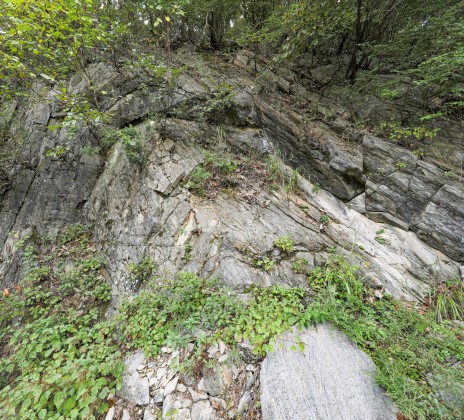 Nodong-ri Thrust Fault
Nodong-ri area, Danyang-eup, Danyang-gun, Chungcheongbuk-do
The Nodong-ri Thrust Fault represents a key structural boundary separating Paleozoic and Mesozoic strata in the Danyang region. At this locality, older Paleozoic sedimentary rocks are thrust over younger Mesozoic rocks, forming a reverse (compressional) fault known as a thrust fault. This structure was generated under intense compressional stress during ancient orogenic (mountain-building) processes, which uplifted deep-seated rocks and emplaced them over shallower, younger strata. The fault zone itself exhibits well-developed fault breccia and fault gouge, which are formed through intense shearing and crushing of rocks along the fault plane during movement. These features preserve physical evidence of the dynamic and powerful crustal deformation that shaped the region. Because it exposes rocks from different geologic eras in direct contact, the Nodong-ri Thrust Fault serves as an invaluable field site for studying the tectonic history, stress regimes, and deformation structures of the Korean Peninsula. Its clear structural exposure makes it an excellent location for educational fieldwork and structural geology research.
-
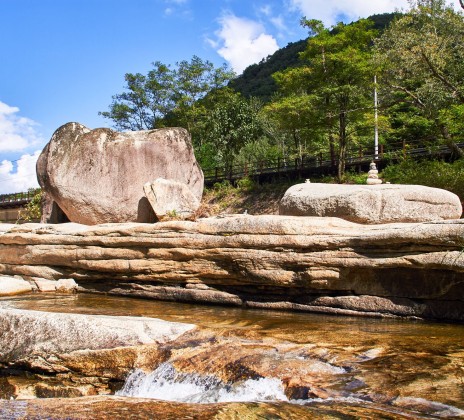 Haseonam
295 Daejam-ri, Danseong-myeon, Danyang-gun, Chungcheongbuk-do
Haseonam is located downstream within Seonam Valley and is designated as one of the Eight Scenic Wonders of Danyang. The granite exposed here formed approximately 89 million years ago, when magma cooled slowly deep underground before later becoming exposed at the surface through uplift, weathering, and erosion. Along the stream, visitors can observe potholes, which are formed by swirling water and sediment grinding into the rock over time. The granite also displays well-developed horizontal joints, showing where multiple intrusive pulses of magma cooled in layered patterns before erosion sculpted the current surfaces. The gentle curves of the granite outcrops, combined with the clear valley water, create a calm and scenic environment. Haseonam provides a comfortable natural resting place, especially appealing to families and casual hikers, and is well-suited for outdoor learning, nature exploration, and quiet reflection.
-
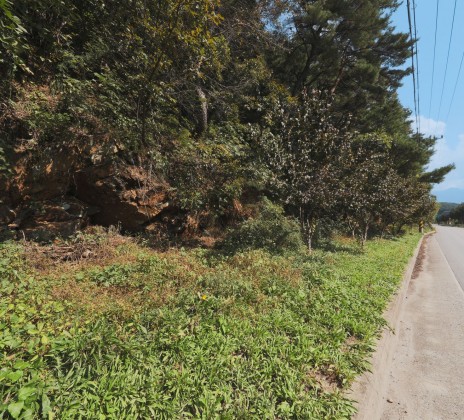 Mercury Evidence of Cap…
557-3 Ha-ri, Yeongchun-myeon, Danyang-gun, Chungcheongbuk-do
The Ha-ri section preserves Middle Permian (Capitanian) marine limestone, within which anomalously high mercury concentrations have been detected. Mercury anomalies are widely regarded as geochemical proxies for large igneous province (LIP) volcanic emissions. This evidence is linked to volcanic activity associated with the Emeishan Large Igneous Province, which released enormous quantities of volcanic gases into the atmosphere. These emissions are understood to have triggered: -Ocean anoxia (loss of dissolved oxygen) -Increased ocean acidity -Collapse of marine ecosystems -A major reduction in biodiversity This site is significant because: -It represents one of the first mercury-based geochemical indicators of the Capitanian extinction reported in Asia, and -It provides direct field evidence for understanding how environmental perturbations can lead to mass extinction events. The Ha-ri section is therefore recognized as a Scientific Geosite, valuable for: - Research on global paleoenvironmental change - University-level geoscience education - Public interpretation regarding extinction and climate change parallels
GEOPARK PROMOTIONAL VIDEO